
From the Eagle's Nest | Fall 2026


How does being Member of NAFWS help you in the work you do?
Hearing testimonials not only makes our day, it really helps us advocate for more support and funding so we can in turn, provide that to you. Drop us a note and tell us how NAFWS impacts your work!

Dear NAFWS BOD Members, NAFWS Staff, Tribal Leaders, Natural Resource Professionals, Partners, Elders, Youth and Friends:
As the seasons change and we move into fall, I am reminded of the important connection between our people, communities, and the natural resources that sustain us. Fall is a time of transition, reflection, and preparation for the responsibilities ahead. It is also a time when many Tribes are harvesting wildlife, fish, and crops, so please be safe.
Across Indian Country, Tribal fish and wildlife professionals continue to demonstrate leadership, knowledge, and commitment to protecting our natural resources. From fisheries and wildlife management to conservation law enforcement, habitat protection, invasive species management, and Traditional Ecological Knowledge, your work strengthens our communities and protects resources for future generations.
The Native American Fish and Wildlife Society remains committed to supporting Tribes in their self-determined management of natural resources. Our strength comes from our Tribal Nations, regional members, and the relationships we build together.
This year has reinforced the importance of a strong, unified Tribal voice. NAFWS continues to advocate for the funding, training, technical assistance, resources, and policies Tribal fish and wildlife programs need. We are facing tough times, and standing together to ensure Tribal priorities are heard at every level matters now more than ever.
I am especially proud of the opportunities NAFWS provides for students and young professionals entering natural resource management. Investing in the next generation means passing on not only scientific knowledge and professional skills, but also the cultural values, teachings, and responsibilities that guide our relationship with the natural world.
As we move through fall, I encourage you to stay engaged with NAFWS. Participate in regional activities, trainings, and conferences. Share your knowledge, mentor young professionals, and strengthen relationships with fellow Tribal natural resource professionals. Take advantage of our growing opportunities for networking, publications, training, and member resources.
I also want to recognize our Board of Directors, Executive Director, Deputy Executive Director, committees, partners, staff, and most importantly, our members. We are a membership organization, and your dedication makes our work possible. Your efforts may not always receive the recognition they deserve, but they make a lasting difference. Every fish protected, acre restored, wildlife population monitored, young person mentored, and Tribal program strengthened contributes to a healthier future.
As Tribal Nations, we have inherited responsibilities from those who came before us and carry them forward for those yet to come. Our work is more than a profession. It is stewardship, service, and a commitment to future generations. Let us enter this fall season with gratitude for what we have accomplished, determination to face the challenges ahead, and confidence in what we can achieve together.
On behalf of the NAFWS Board of Directors, thank you for your continued leadership, partnership, and dedication to our lands, waters, fish, wildlife, and communities. May we continue to walk together and carry our responsibilities forward for the next seven generations.
With gratitude and respect,
Donald J. Reiter, President
Native American Fish and Wildlife Society

Greetings NAFWS members, partners, and friends! Fall is upon us on Cheyenne River and I welcome the changes and the beauty it brings. I’m not as excited about the box elder bugs!
The summer months have always been a time for NAFWS to provide trainings and host our summer youth practicums. In July we held the annual National Summer Youth Practicum in Colorado and for the fourth year, an Alaska Summer Youth Practicum in Anchorage. NAFWS has been hosting these educational experiences for over 30 years, with impacts deeper than purely the number of students served. We witnessed this impact at the Southeast Tribal Environmental Forum seeing Cer Scott, a NAFWS National Summer Youth Practicum alumnus, serve the Tlingit and Haida Natural Resources Department. Cer gave NAFWS a special shoutout and shared how the SYP helped launch his career in conservation. Thanks Cer, we see you and we are PROUD of you and being a small part of your journey.
In quarter three, we hosted a Grantseekers retreat for National Fish and Wildlife Foundation (NFWF) Tribal grantees and those seeking grants for nearly 30 participants representing 13 Tribal nations across the country in Polson, MT, hosted by the Confederation Salish and Kootenai Tribes of the Flathead Reservation. A 40-hour Conservation Law Enforcement Officer (CLEO) training was held in Quapaw, OK with 19 CLEOs participating in the five-day training that included Wilderness First Aid Training. In addition to our in-person trainings we continued our virtual offerings, including a GIS in Invasive Species training for nearly 200 participants all over the world. Mitzi Reed joined our partners from the Alabama Fire College to conduct a 40-hour HAZWOPER training at the Bad River Tribe in Wisconsin.

Our grants team conducted many site visits throughout Indian Country learning about the NFWF grant projects and the many other projects Tribes are doing in conservation. One highlight for me was a trip to coastal Alaska accompanied by most of the AK Team. We stayed at the Native Village of Shaktoolik, where I witnessed climate and community resilience in real time. I also learned many things, such as basketball culture is alive and well in Indian Country, I am not tough enough to live in rural Alaska full time, and there is so much beauty in nature even as she is under attack from constant natural and human impacts. We met with the Nome Eskimo Community during our layover in Nome and got to see the local muskox herd.

NAFWS Regional Directors have been busy in the past few months with Regional Conferences in the Southwest, Alaska, Great Lakes and Southeast. Each of the conferences was well attended with informative sessions, recognition of outstanding work and individuals, natural resources tours and, as always, amazing food. Read more about each event HERE.
NAFWS continues to monitor, share and respond as much as possible to proposed, actual and unknown changes from our federal partners and leaders. In July, NAFWS provided written comments on the Office of Management and Budget’s proposed rule, “Regulation for Federal Financial Assistance” (OMB-2026-0034). We were encouraged to see the Continuing Resolution block the proposed changes, at least through December 11, 2026. In September, NAFWS staff, board and Tribal representatives from Jamestown S’Klallam Tribe, Council of Tlingit and Haida, Pueblo of Santa Ana conducted a Tribal fish and wildlife DC fly-in. We met with 32 Congressional offices, 4 committees in 2 days. We are very concerned with the recent Executive Order 14429, “Reinvigorating America’s Hunting Heritage” with no mention of Tribes, the original hunters of these lands. Please join our next Tribal Policy Working Group, October 29th to learn more regarding these changes and legislation we are tracking.
In 2025 the NAFWS membership passed Resolution 2025-002 “Membership with American Wildlife Conservation Partners” to seek membership to the AWCP and for the Executive Director work on the application process for the betterment of conservation on Tribal lands. We have been working on this process. We secured the required three letters of support and Sean Cross and Art Lawson presented our application during AWCP’s summer meeting in Cody, WY. We were extremely disappointed when our vote for membership was tabled until next summer. I have been requested to present at the Wildlife Management Institute’s North American Wildlife and Natural Resources Conference in March 2027. I will present in March and report to NAFWS membership at our 2027 National Conference. Staff and the Board of Directors visited the Santa Ana Star Casino Hotel in Bernalillo, NM in September, the 2027 National Conference site. We met with the host staff of Pueblo of Santa Ana and the hotel staff to finalize our contract. The Board of Directors also met for their regular quarterly meeting and participated in a strategic planning workshop.
On my drive home last week I came upon a group of migrating hawks, stopped in a field next to the road. It was something I’ve never seen before and truly an incredible sight. It had me reflecting on the value of pausing and resting. The journey may be long and full of challenges, but there is a time to rest. I hope you all make the time to take care of yourselves and each other and remember to rest along the journey.

We remain committed to our mission of assisting Native American and Alaska Native Tribes with the conservation, protection and enhancement of their fish and wildlife resources. As always, if you have ideas for NAFWS, please contact me or your regional director(s).
Pilamaye ye,
Julie Thorstenson, PhD (Lakota)
Woksape Gluha Mani Winyan
Executive Director
Welcoming Our New Pacific Regional Director

My name is Kalela Reuben, I am 26 years old, and an enrolled member of the Nez Perce Tribe (Nimiipuu). I serve as a Fish & Wildlife Enforcement Officer with the Nisqually Indian Tribe and as the Pacific Regional Director and Conservation Law Enforcement Officer Representative for NAFWS. I believe Tribal nations have the knowledge, values, and leadership to be at the forefront of conservation efforts worldwide. I am passionate about strengthening tribal conservation programs, expanding training opportunities, and empowering future generations. And as a mother of two, preserving our natural resources and cultural traditions is deeply personal to me.

The NAFWS Conservation Law Enforcement Officer (CLEO) Program had a busy quarter, bringing Tribal conservation officers together for hands-on training, regional competitions, and opportunities to strengthen partnerships and share knowledge.
40-Hour CLEO Training | Quapaw, Oklahoma
From August 10–14, 19 CLEOs representing 11 Tribal Nations participated in five days of intensive training hosted by the Quapaw Nation. Officers completed a three-day Wilderness First Aid course led by Desert Mountain Medicine, followed by two days of advanced firearms training. Exercises focused on live-fire qualifications, movement and transition drills, tactical decision-making, and reduced-light familiarization to strengthen officer safety, proficiency, and field readiness.
The firearms training was led by Tribal CLEOs from the Three Affiliated Tribes, Miccosukee Tribe, Miami Nation, Quapaw Nation, and Muckleshoot Indian Tribe. Special thanks to the Quapaw Nation, Desert Mountain Medicine, and the U.S. Fish and Wildlife Service Office of Law Enforcement for their hospitality, instruction, and support.
Southwest Regional Conference | Tucson, Arizona
From August 17–20, 13 Tribal conservation officers representing nine Tribes gathered at the Southwest Regional Conference, hosted by the Tohono O’odham Nation. Officers participated in a two-day Tactical Tracking course led by Greenside Training, LLC, combining classroom instruction with practical field exercises.
Nine CLEOs representing seven Tribes also competed in the Southwest Regional Practical Pistol Competition for the opportunity to represent their region at the National CLEO Shoot Competition.
During the regional CLEO meeting, officers discussed shared concerns, priorities, and training needs. Chief Korwin Atole of Jicarilla Apache Fish and Game was unanimously re-elected by his peers to serve another three-year term as the Southwest Regional CLEO Representative on the NAFWS CLEO Committee.
Great Lakes Regional Conference | Bay Mills, Michigan
CLEOs attending the Great Lakes Regional Conference gained valuable hands-on experience during a sonar training session on Back Bay of Whitefish Bay. Led by Keith Cormican of Search and Recovery Consulting, LLC, the training allowed officers to apply sonar technology in realistic search scenarios and explore its use in search and recovery operations.
The region also held its annual Practical Pistol Competition, bringing together 18 officers representing nine Tribes from Minnesota, Wisconsin, and Michigan. Participants tested their skills in a practical shooting course, with top-scoring officers earning the opportunity to advance to the National CLEO Shoot Competition.
Supporting Tribal Conservation Law Enforcement
Through specialized training, practical exercises, and regional collaboration, the NAFWS CLEO Program continues to support the professional development and preparedness of Tribal conservation officers. We thank the Tribal Nations, instructors, partners, and participating officers whose dedication makes these opportunities possible and strengthens conservation law enforcement across Indian Country.
NAFWS is celebrating in our Education Programs!
National Summer Youth Practicum
CONGRATULATIONS to the 2026 National Summer Youth Practicum’s Magpie Team – Liam, Cayden, LeAnnabah, Daniel (and Hank) for being selected to attend the 2027 NAFWS Annual National Conference in Bernalillo, New Mexico. Let’s take a step back to our time at the 2026 National Summer Youth Practicum (NSYP).
We welcomed 16 students from 13 Tribes to Northern Colorado to participate in the NSYP. Our hot summer days consisted of learning about our winged and finned relatives to creating vision boards of the students' future goals. As part of the NSYP, we had a SYPER Tribal Council Meeting where students were challenged to create a public service announcement (PSA) to call action and awareness to a natural resources concern. Throughout the week students worked together to utilize the available tools and learned knowledge to create their PSA to present at the end of the week. For full final report, please review HERE.
Scholarships
Our full and second CONGRATULATIONS go to the 2026 NAFWS National and Regional Recipients. We received 68 applications from undergraduate and graduate students across all seven regions. Through reading and reviewing the wonderful essays, kind words from recommenders, and diverse involvement in resumes, NAFWS selected 17 students to receive scholarship funding, the breakdown are as follows:
- 7 National Scholarships
- 3 Northeast Region Scholarships
- 2 Pacific Region Scholarships
- 2 Southwest Region Scholarships
- 2 Great Plains Region Scholarship
- 1 Great Lakes Regional Scholarship
To learn more about our 2026 NAFWS National & Regional Scholarship Recipients, we invite you to read their biographies HERE.
For questions about NAFWS Education Programs, please contact Ashley Mueller, Education & Advancement Director, at amueller@nafws.org.

BIO Corner

The Tribal Fish and Wildlife Working Group is a Tribal-only forum dedicated to advancing the conservation, protection, and enhancement of fish and wildlife resources across Tribal lands and communities. Meetings are held virtually, enabling broad participation and regular dialogue among tribal natural resource professionals. Discussion topics include, but are not limited to:
Wildlife connectivity and habitat conservation
Wolf management
Ungulate Conservation
Pollinator conservation
Reptile and amphibian management
Fisheries, aquatic ecosystems, and water-related resources
Other priorities related to Tribal fish and wildlife management
Through this working group, participating Tribes strengthen partnerships, exchange best practices, and support the long-term sustainability of the natural resources that are vital to their cultural, ecological, and community well-being.
Upcoming Meetings:
Join us on October 20 for a presentation by Sergio Gonzalez of the Seminole Tribe during the Reptile and Amphibian session. Presentation: The Cuban Tree Frog (Osteopilus septentrionalis) – Reconsidering Its Origins in Florida
Join us on November 17th for a presentation by Seminole Tribal Forester Grant Steelman during the Fisheries and Aquatics session. Presentation: Management implications of multi spectral drone data in natural resources and assessing drought impacts.
Webinar: Strengthening Wildlife Conservation Through Wildlife Health: An Introduction to VIEW
The Native American Fish & Wildlife Society (NAFWS), in partnership with the Veterinary Initiative for Endangered Wildlife (VIEW), is hosting an informational webinar on Wildlife Health Management in Conservation.
The webinar will introduce VIEW and its approach to supporting wildlife health through conservation partnerships, training, disease surveillance, data management, and capacity building. VIEW will share examples of its work, while highlighting opportunities to support Tribal wildlife health programs and conservation efforts.
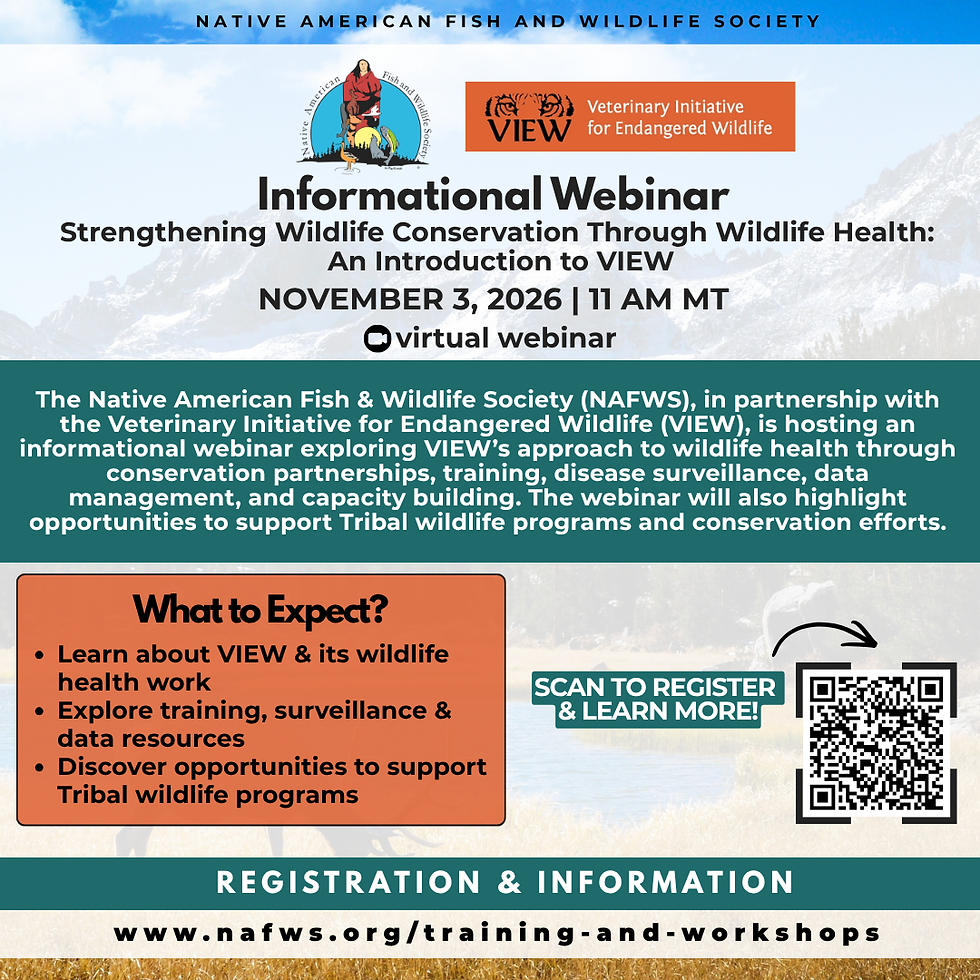
What to Expect:
Introduction to VIEW and its wildlife health programs
Examples of VIEW’s conservation and wildlife health work
Overview of training, surveillance, and data management resources
Discussion of potential collaboration and support for Tribal wildlife programs
Time & Location: Nov 03, 2026, 11:00 AM – 12:00 PM MST on Zoom. Please register HERE.
Wildlife Health Surveillance and Management Workshops
Please keep an eye out for our NAFWS Story Map on our Events & Training page on the website for upcoming Wildlife Health Surveillance and Management Workshops. This peer-to-peer training supports Tribes in designing and implementing Wildlife Health Management Plans tailored to their lands, cultures, and priorities. Through shared Tribal expertise, participants build capacity to detect, respond to, and manage wildlife diseases while strengthening sovereignty and collaboration.
The next workshop will be the Wildlife Health Surveillance and Management Workshop at the 2026 NAFWS Pacific Regional Conference.
Tribal Mapping Project
The Native American Fish and Wildlife Society’s Tribal Mapping Project is a collaborative initiative designed to strengthen Tribal capacity in wildlife movement analysis, geospatial data management, and conservation planning. The project provides technical assistance and training, as well as secures data while supporting Tribes in collecting, managing, and analyzing wildlife movement data for species such as elk, mule deer, and pronghorn. The Tribal Mapping Analyst provides support in mapping migration corridors and core seasonal habitat. The project strives to advance Tribal-led conservation while upholding the principles of Tribal data sovereignty and self-determined natural resource management. This effort ensures that Tribes have equitable access to modern mapping tools and analytics needed to make informed wildlife and land management decisions.
The Tribal Mapping Project is excited to announce that we have partnered with the University of

Wyoming, Merkle Lab to bring the Wildlife Movement Database App to all Tribal Nations.
Through NAFWS, Tribes now have FREE access to this valuable tool!
The Wildlife Movement Database App platform allows users to explore species movement patterns, migration corridors, seasonal habitat use, and spatial ecology data that can support informed resource management decisions.
Access to this database can benefit Tribal Nations by helping to:
Identify important migration corridors and seasonal habitat use areas
Support habitat conservation and restoration planning
Strengthen wildlife management and monitoring programs
Inform infrastructure and land-use decisions to reduce impacts to wildlife movement
Enhance grant applications and conservation funding proposals with spatially supported evidence
Build capacity for long-term landscape-scale wildlife stewardship

This platform is a powerful resource for integrating wildlife movement science into Tribal conservation planning and management efforts. NAFWS can also provide guidance and support for Tribal staff interested in learning how to use the app and apply its data to local management priorities. If you are interested in learning more or would like to begin accessing or exploring the database, please reach out.
As a reminder: The NAFWS Tribal Mapping Analyst is available year around for virtual technical assistance to support your mapping projects. For help with your geospatial needs, reach out to Emily Hagler at ehagler@nafws.org.
Research and Publications Committee Updates
The Research & Publications Committee supports Tribal fish and wildlife professionals in sharing research that reflects Tribal priorities and values, with a focus on best practices, Tribal data sovereignty, and knowledge exchange.
Submissions for Issue 2 of From the Field: Elevating Indigenous Voices have now closed, and the review process is now underway.
For more information or to get involved, please reach out to Hannah Golden at hgolden@nafws.org.
National Environmental Policy Act Training (NEPA)
The NEPA training provides Tribal field staff with the knowledge and skills to successfully complete National Environmental Policy Act (NEPA) planning and processes. Participants learn about NEPA compliance levels, Tribal consultation, DOI policies, and key legal considerations that support environmental protection and Tribal sovereignty.
A virtual course was conducted in September and an in person course is scheduled for October hosted by the Santa Ynez Band of Chumash Mission Indians in Santa Ynez, California. This course will conclude the 2026 NEPA training schedule, but we are planning more courses for 2027 with a series designed specifically for Alaska Tribes and Alaska Native Villages.
For details, registration, or travel assistance, contact Sean Cross at scross@nafws.org
National Conservation Library MOU
NAFWS and USFWS staff met the early part of September to begin the Memorandum of Understanding that allows NAFWS members and staff to access the 9000 plus professional journals the Conservation Library has subscriptions to. Utilizing the library is included in your membership and is easily accessible allowing members to conduct searches across all the journals at once. For instructions on how to access, click HERE.
Please contact Sean Cross scross@nafws.org for further information.
It was a busy season in Alaska for NAFWS! This year NAFWS staff hosted or assisted with 9 events in the region, which is nearly triple the number of events we hosted in previous years. Thank you to everyone who hosted and attended events in 2026, and we will continue to take your feedback and training requests for 2027.
Intro to Forestry Course
In late June, the Director of Tribal Engagement – Alaska, and the Alaska Region Biologist, partnered with Copper River Native Association to deliver a hands-on Intro to Forestry Course supported by Prince William Sound College, where attendees earned college credit for their participation. This course was designed for youth ages 15 – 25 and was carried out on forest land that's being actively managed by Ahtna Athabascan youth crews for benefit to forest health, wildfire management, and community members including a wood delivery program for elders.
Alaska Summer Youth Practicum
In July we hosted the Alaska Regional Summer Youth Practicum (AK SYP) near Anchorage, AK. Our 4th time hosting this event, we had 9 student participants from 7 different federally recognized Tribes across the state. Guest speakers this year were from: Alaska Nannut Co-Management Council, Chickaloon Village Traditional Council (CVTC), Eklutna Native Village, Cook Inlet Tribal Council Youth Leadership Program Interns.
Our agenda included presentations and hands-on activities: History of Alaska Fish & Wildlife Management from an Alaska Native context; Walking in Two Worlds, Braiding Indigenous Knowledge and Western Science; a day in the field with CVTC at the Tsidek'etna salmon restoration site; a tour of facilities at Eklutna Native Village by CITC Youth Interns, including help with chores in the community garden and identifying salmon habitat on Eklutna River; career and education pathways from camp chaperones; and film making lessons from SeeStories.
One goal of the AK SYP is for Alaska Native students to learn about Tribal natural resource stewardship, and this year that also meant learning how to tell a story about stewardship within cultural identity. Throughout the week, students worked with SeeStories to develop filmmaking and interviewing skills and create their own short films about Tribal stewardship. Their experiences took them from studying stream ecology, salmon habitat, native plants, and community food systems with local Tribes, to conversations about Indigenous knowledge, Western science, education, career pathways, and cultural identity and pride. A huge thank you to SeeStories for sharing their time and expertise with Alaskan Youth. Thank you to the Tribal communities, partners, presenters, chaperones, families, funders, and supporters who shared their knowledge and made AKSYP possible—and especially to our students for bringing their own voices, perspectives, and creativity to the experience.
Annual Site Visits
In August, Alaska staff and Executive Director conducted annual site visits in Alaska. This year we traveled to the Northwest region of Alaska and visited Shaktoolik AK where staff toured the community led by Jolene Auliye, NAFWS Tribal Engagement Specialist-Alaska Region. In Shaktoolik we met with the Relocation Managed Retreat Coordinator and Tribal President to hear about their ongoing projects for community resilience, environmental and wildlife changes they've witnessed, and funding concerns. We ended our annual site visit with time spent in Nome where we received a tour with an ADFG Musk Ox Research Biologist. And a visit with the Nome Eskimo Community with discussions on development impacts to food security, IGAP planning, an increase in occurrence and concerns for harmful algal blooms, and threats to berry patches. At the end of August Kristi Tapio-Harper, NAFWS Tribal Engagement Specialist, attended the Southeast Tribal Environmental Forum in Juneau and presented on NAFWS’s programs.
Alaska Regional Conference
September was our annual NAFWS Alaska Regional Conference which was held outside of Anchorage AK for the first time. This year we were hosted by the Sitka Tribe of Alaska in Sitka, AK on September 1 – 3. The theme of the conference was “Asserting Sovereignty through Science.” There were two workshops held on the first day of the conference, a Marine Mammal Workshop and Necropsy, and a Tribal Conservation District Meeting with USDA NRCS. The General Session was held on the second day, and included a keynote address by Mike Miller, Indigenous People’s Council for Marine Mammals and Sitka Tribal member. The last day of the conference participants went on natural resource tours at Sitka Tribe’s Biotoxin Lab and the Sitka Sound Science Center and gathered for the traditional feast to end the week.
A Full Toolbox is the Way to Go
When it comes to invasive species management, integration of multiple tools is often the best way to combat invasions. Best practices for management and control include the combination of early detection, use of multiple tools or strategies, integration of new technologies, and protocols that help guide rapid response and programming. Just like an auto mechanic, it’s important to explore new tools that roll out because as my dad has always said “you never know when you may need it”, whenever he was purchasing a new tool at the tool shop. Building your invasive “toolbox” with knowledge, techniques, equipment, and protocols only makes your management and control strategies more efficient.
Making new connections, learning new information, and sharing your challenges and successes can be as vital as the contents of a training course. Building rapport with other managers can be an invaluable “tool in the toolbox” for those dealing with invasive species issues that seem never-ending. Tricks and tips can be shared to provide another alternative way to combat invasions. The trial-and-error stories collectively provide guidance on how to approach a situation, and the humorous narratives help build personal relationships that bridge partnerships, as well as provide assurance that you are not alone when something doesn’t go as planned.
NAFWS events are ideal places for these personable opportunities, especially our Regional and National Conferences. The Invasive Species Team is looking forward to planning some of these opportunities to help you fill those toolboxes while making connections at our upcoming workshops and conferences in 2027. We hope you can join us!
The NAFWS Invasive Species Team is available to discuss concerns, issues, and strategies that can help you target any invasive or undesired plant species, so please feel free to reach out:
Team Updates

Welcome to Fall! Since our last update in early July, the Grants Team has been on the go. We wrapped up July with our 2026 Grant Seeker Retreat, hosted by the Confederated Salish and Kootenai Tribes (CSKT) in Polson, Montana, July 28–29. Twenty-nine participants from 13 federally recognized Tribes, 1 Tribal organization, 1 Tribal business, 5 partnering NGO’s, and 1 state university came together for a day in the classroom for a workshop titled “From ‘First Idea’ to ‘Hit Submit’: Practical Skills for Grantseekers” where they discussed ways to diversify their funding searches and sources, leverage and stretch resources, were provided grant writing tips, and completed hands on activities from brainstorming to drafting and reviewing grant proposals. The second day consisted of an awesome field trip led by CSKT staff highlighting some of their grant funded and other projects, including a visit to their greenhouse facility and the CSKT Bison Range. We’ll be scheduling events for 2027 in early December, so stay tuned for additional opportunities!
Site Visits
Since the retreat, our Grants Team has been busy traveling and visiting 16 Tribal programs to learn about projects funded through the National Fish and Wildlife Foundation’s (NFWF) America’s Ecosystem Restoration Initiative and National Coastal Resilience Fund. These visits highlight how grant funding supports Tribal natural resource goals and builds program capacity, while also providing valuable insight into Tribes’ experiences with the grant process, from application to post-award management. As a contracted liaison with NFWF, we use this feedback to help improve Tribal access to funding and opportunities for success.
Above: The Skokomish Indian Tribe in Washington is implementing a largescale stream restoration project, using engineered logjams to restore natural stream processes of sediment transport, increase channel complexity, and provide habitat for salmon and other fish – addressing legacy impacts from past logging and more recent impacts from catastrophic wildfires and changing storm patterns.
Speaking of NFWF funding, congratulations to the Quileute Tribe and Hoopa Valley Tribe on receiving Healthy American Forests Initiative awards, and to the Yurok Tribe, Summit Lake Paiute Tribe, Three Affiliated Tribes of the Mandan, Hidatsa, and Arikara Nations, and Pueblo of Santa Ana on their Western Big Game Seasonal Habitat and Migration Corridors Fund awards! While not all Tribal applicants were selected, we're encouraged to see strong Tribal representation among awardees.
We've also learned that the Bureau of Indian Affairs (BIA) has begun notifying applicants about FY26 awards for its Endangered Species, Invasive Species, Tribal Youth Initiative, and Fish Hatchery Maintenance programs. Midwest Region awardees were notified and contracting was completed by October 1, though timelines may vary elsewhere. If you applied and haven't heard back, check your email or contact the regional BIA representative listed in the original RFP.
While FY27 funding announcements are still pending, it's never too early to start planning projects and drafting proposals! NAFWS members can access recorded webinars covering all four BIA programs through the Member Portal under Member Resources > Webinar Recordings. We'll provide updated webinars once FY27 details are available, and our team is here to help with applications.
While you're there, check out our Self-Determination webinar series, including the October 7 presentation by Dr. Seth Moore, Natural Resources Director for the Grand Portage Band of Lake Superior Chippewa, “Grand Portage: Self Governance in Action.” You'll also find information on the Land and Water Conservation Fund's Outdoor Recreation Legacy Partnership funding opportunity, with applications open through November 1.
A sampling of additional funding opportunities currently available include:
Great Lakes Restoration Initiative Community Forest and Open Space Conservation Program
National Fish Passage Program
Great Plains Grassland Fund
Outdoor Recreation Legacy Partnership Funding Program
Visit the NAFWS Funding Resources Dashboard to learn more about these and other opportunities. As always, the Grants Team is available to help members brainstorm projects, identify funding opportunities, review proposals, and provide grant-related technical assistance and training.
BOOK A MEETING AT THIS LINK: https://outlook.office365.com/book/ATBCTechnicalAssistancewithNAFWS@nafws.org/
Upcoming Events

Job Opportunities
Visit our job board that is regularly updated with new internal and external positions.

Congratulations on reading all the way to the end! We are glad to have you as a NAFWS Member.

Comments